5 Kitchen Trends for 2026 That Will Transform Your Home
The biggest kitchen design trends are transforming how we live in 2026
If you’re planning a kitchen remodel or simply curious about where design is heading, 2026 is bringing some genuinely exciting changes.
After 15 years of stark white boxes and cold minimalism, kitchens are finally becoming warm, personal, and human again.
I’ve been analyzing what top designers are predicting, what’s showing up in luxury showrooms, and what homeowners are actually asking for. And honestly? These aren’t just aesthetic shifts.
These are fundamental changes in how we think about kitchens — not as sterile work zones, but as the emotional heart of the home.
Let me walk you through the five biggest trends you’ll see everywhere this year.
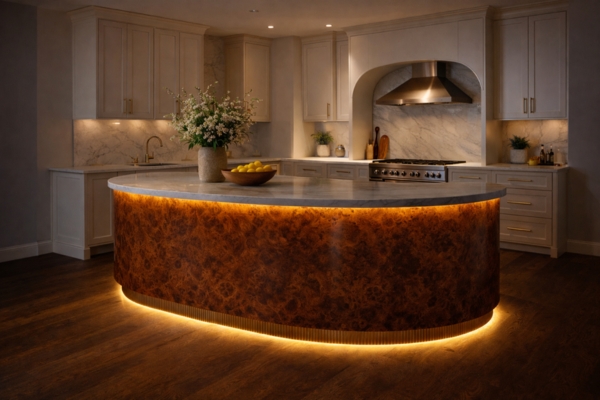
Trend #1: Rounded Curves Replace Sharp Angles
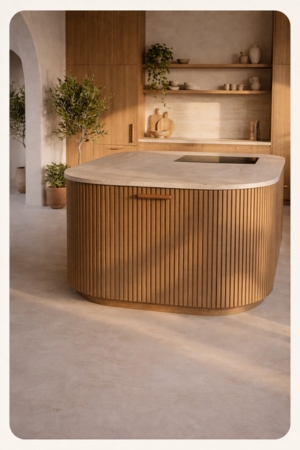
Why straight lines are disappearing
For the last 15 years, most kitchens looked like “white boxes.”
Sharp corners. Straight lines. Everything felt strict and institutional.
But this year, that’s completely changing. Designers are moving away from hard angles and replacing them with fluid lines and soft curves.
Curved islands. Rounded corners. Arched doorways.
And this shift isn’t just visual. It changes how a kitchen feels — and how people actually move and connect inside it.
The science behind curves: neuroaesthetics
There’s actually a term for this in design — neuroaesthetics.
Our brains read curves as safe, and sharp angles as a mild threat.
You don’t consciously notice it, but your nervous system does.
When your body relaxes, the way you use the space changes too. Traditional rectangular islands line everyone up, facing forward — conversations feel stiff, almost like a classroom.
A curved or oval island changes that.
People naturally face each other. Conversations flow. The kitchen becomes a place to linger, not just pass through.
How curved designs became affordable
You might be thinking this all sounds great, but doesn’t building with curves seem really difficult and expensive?
Well, not anymore.
In the past, curved cabinetry meant steaming and bending solid wood — slow, expensive, and highly specialized. That’s why you almost never saw it outside of very high-end projects.
Today, materials have changed.
Designers now use flexible plywood panels that bend smoothly without cracking, and lightweight foam cores that allow large curved islands or walls to be built without heavy steel framing.
Thanks to this new technology, you’re going to start seeing these curves showing up everywhere.
Where you’ll see curves in modern kitchens
From the largest architectural elements down to the smallest details:
Arched doorways and curved walls add architectural interest. Oval and rounded islands become natural gathering spots. Softened cabinet edges feel gentler to the touch. Rounded hardware you feel more than you notice.
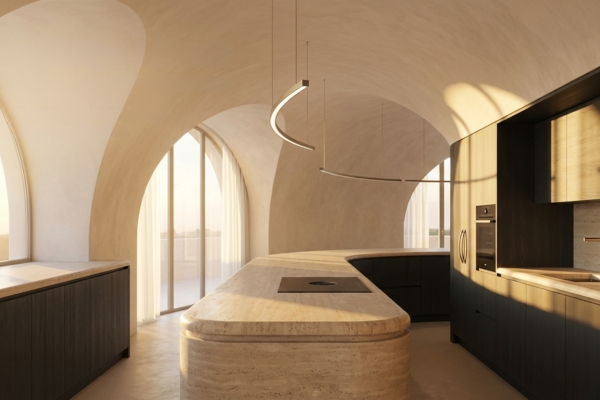
The effect is subtle but powerful.
Your kitchen stops feeling like a showroom and starts feeling like a sanctuary.
Trend #2: Vintage Hardware Becomes Your Kitchen’s Jewelry
The end of invisible hardware
For the last few years, people tried to make cabinet handles disappear.
They used “touch latches” (where you push the door to open it) or simple black bars that you would barely notice.
In 2026, that is completely over.
Now, hardware is considered the “jewelry” of the kitchen. It’s designed to be noticed, to look like art, and to act as a “narrator” that tells a story about the room’s history.
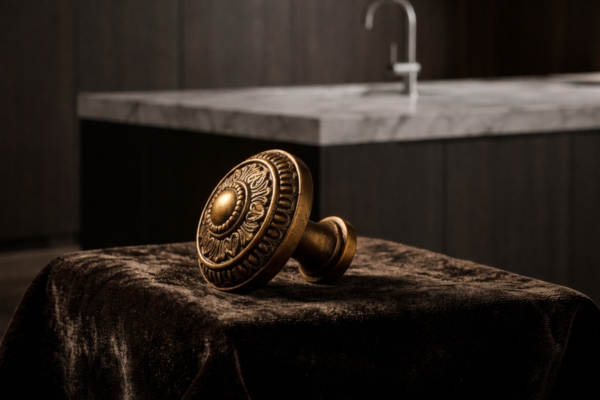
Cremone bolts: the return of the click
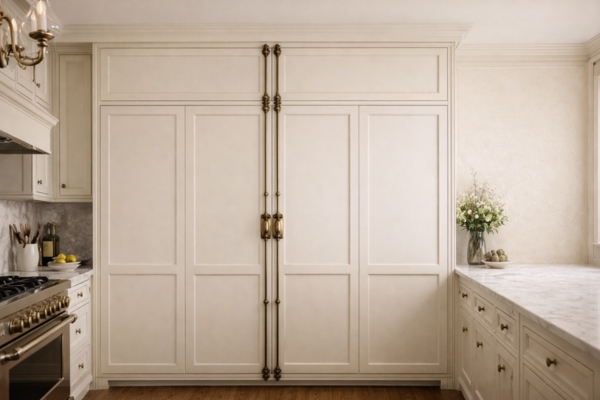
The biggest star of this trend is something called the Cremone Bolt.
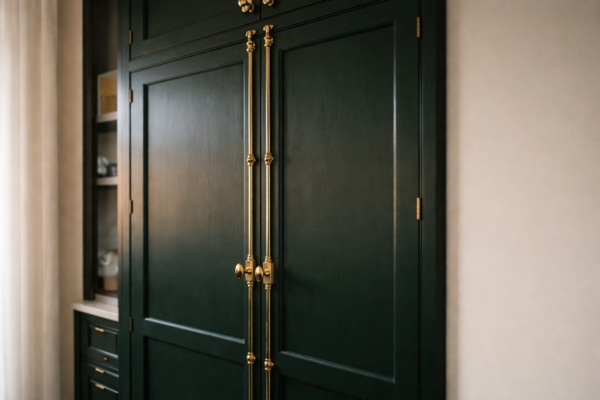
What it is: This is an old-fashioned lock mechanism that was originally used on French windows in the early 1900s. It’s a long metal rod that runs all the way from the top of the cabinet to the bottom.
How it works: Unlike modern hinges that hide inside the door, the Cremone Bolt sits right on the front. To open the cabinet, you have to turn a knob in the middle, and you can actually feel the rods moving up and down to unlock it.
Why people love it: Designers say this turns opening a pantry into a “ritual.” It feels satisfying and mechanical, not just passive.
It also adds a vertical line that makes cabinets look taller and more architectural.
Living finishes: metal that tells your story
In the past, everyone wanted faucets that stayed perfectly shiny forever.
Now, the trend is “Living Finishes.”
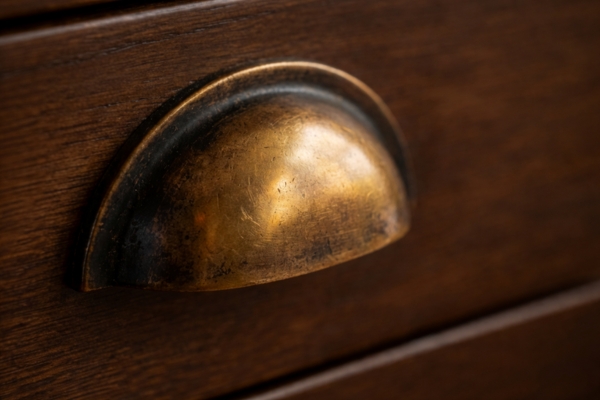
What happens: These are metals like unlacquered brass or oil-rubbed bronze that don’t have a protective shiny coating. Over time, oxygen and oil from your hands make the metal darken or tarnish.
The story: This is done on purpose!
The handle will stay bright where your thumb touches it but get dark in the corners. This creates a “patina” that proves the kitchen is actually used and loved, rather than looking like a fake showroom.
What’s out: Plain matte black hardware is declining because it looks flat and dates the kitchen to the past decade.
Texture: hardware you want to touch
Because we touch handles every day, 2026 designs focus on how they feel, not just how they look.
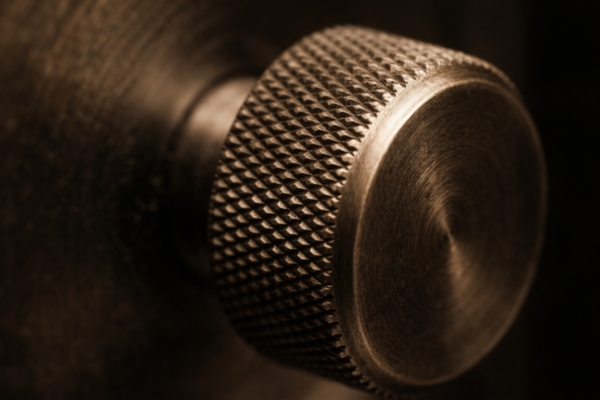
Knurling: This is a diamond-cut pattern carved into the metal. It looks like the grip on a tool or a heavy machine. It catches the light and gives you a good grip.
Hammered finishes: These look like a blacksmith hit them with a hammer, leaving little dents that reflect light softly.
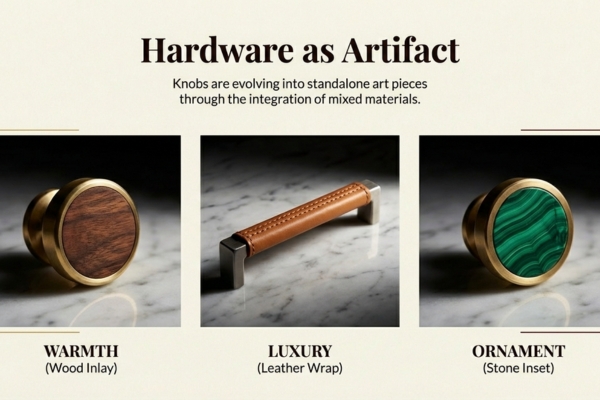
Mixed materials: Some knobs are now acting like mini art pieces by mixing metal with wood, leather, or even colored stones.
The “statement pull” strategy
Designers warn against using the exact same knob on every single drawer. That can create a “polka dot effect” that looks cluttered.
The fix: Instead, they use a “Statement Pull.” This is a huge, fancy handle used only on big things like the refrigerator or a large pantry.
The mix: Then, they use smaller, quieter knobs on the regular drawers.
This creates a balanced look where the big pieces stand out.
Trend #3: Burl Wood Cabinets Transform Kitchens Into Fine Furniture
Moving beyond basic white oak
For the last ten years, almost every “nice” kitchen used the same type of wood — white oak, cut into very straight, even lines.
It looked clean and modern, but after a while, everything started to look the same.
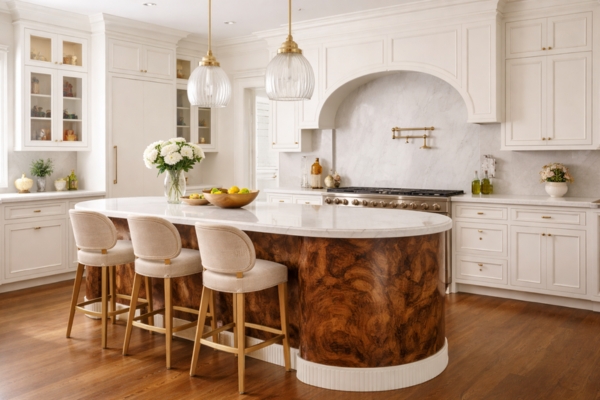
But, in 2026, designers are using something wild and totally unique: burl wood.
What is burl wood?
A “burl” is actually a growth on a tree.
It’s basically a big, rounded bump that forms on the trunk when the grain grows in a deformed way. Think of it like a tree’s weird, but beautiful, scar.
Designers are loving super rich, expensive-looking types like Italian Puzzle Piece Walnut and Gabonese Mahogany. (And yes, those names sound as fancy as the wood looks!)
Why this unique wood grain is suddenly popular
Think about it: we live in a world where our phones, our cars, and even our art can be made perfectly identical by computers and AI.
So designers are pushing back!
We’re starting to crave things that a machine can’t perfectly replicate, things that feel real and completely one-of-a-kind. That’s where burl wood comes in.
Because burls are natural deformities, no two sheets of wood are ever the same.
Using it guarantees your kitchen is unique.
Smart ways to use burl in your remodel
The island-only approach: The most common way you’ll see burl used is on the island. It becomes the focal point — almost like a sculptural piece — while the rest of the cabinetry stays simple and solid, so the room doesn’t feel heavy.
Lower cabinets only: Another approach is using burl on the lower cabinets only. This keeps the upper walls and cabinets light and bright, so the space doesn’t feel like a dark cave.
Small spaces: If it feels like too much for the main kitchen, it’s perfect in a smaller space — a butler’s pantry, a bar, even a coffee nook.
Pairing burl with dramatic stone
You can’t pair a material this expressive with a plain, flat countertop — it just doesn’t hold up.
Burl needs something with equal presence, which is why it’s often paired with dramatic stone — onyx, or deeply veined granites like Mascalzone.
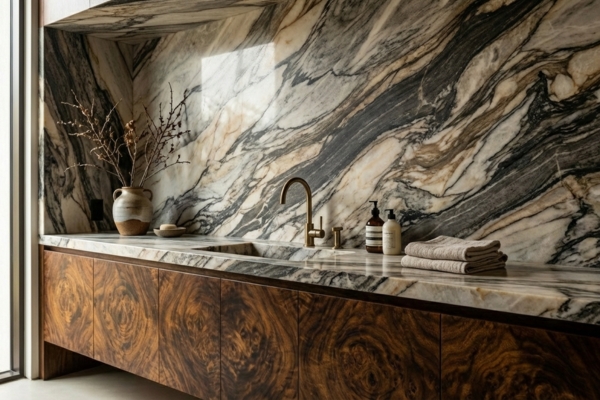
These surfaces have their own movement, so they can stand up to the energy of the wood instead of fading into the background.
Trend #4: Bold Countertops Bring Geological Drama
Stone as art, not just surface
Designers are now looking for “geological drama.” This means they want stone that looks wild, colorful, and intense.
The goal is to turn your countertops into a piece of art.
Calacatta Viola: the must-have stone
If you see one stone everywhere in 2026, it will be Calacatta Viola.
It has a creamy white background with burgundy, violet veins.
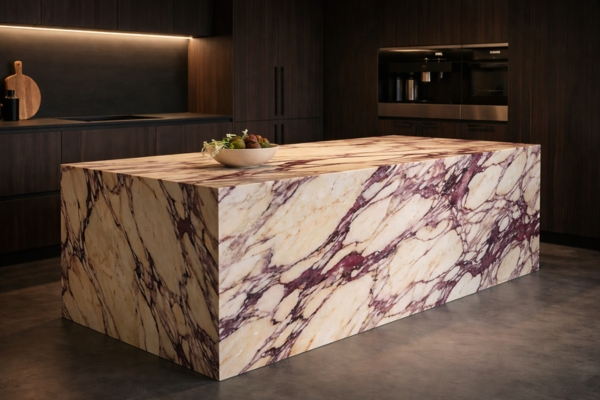
Why it’s popular: It connects “warm” colors (like wood) with “cool” colors (like white paint). Because it’s so bold, it acts like a painting in the middle of the room.
Experts call it the “must-have” material of the year.
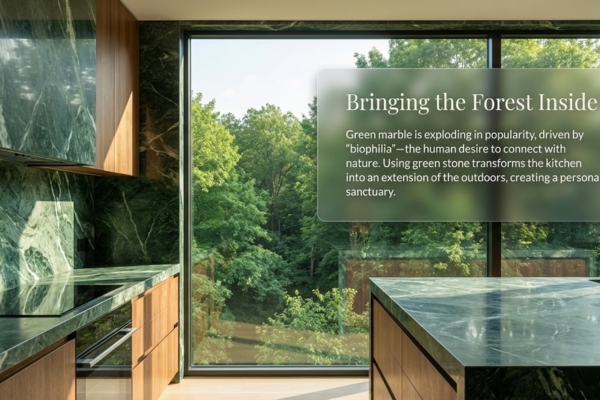
Green marble connects you to nature
But if purple isn’t your thing, don’t worry — the next trend brings the great outdoors right into your kitchen.
I’m talking about green marble.
On one hand, you have stones like Verde Alpi, which has this beautiful, soft sage green color that feels incredibly peaceful and serene.
But on the other end, you have stones like Rainforest Green, which have these wild, chaotic patterns that honestly look like a slice of a jungle.
The power of biophilia
This all ties back to a core idea called “biophilia.” It’s a fancy word, but all it means is that humans have a deep love for nature.
By using these earthy green stones, you make your kitchen feel like an extension of the outdoors.
The seamless backsplash revolution
Now let’s talk about what’s happening with backsplashes.
For years, the old way of doing a backsplash was to use small tiles with tons of white grout lines.
In 2026, designers are ditching tile and running the same stone from the countertop straight up the wall.
Here’s why:
It gets rid of ugly grout lines that are hard to clean. It creates a “seamless” look that makes the stone look like a giant mural or wallpaper made of rock.
And let’s be honest, it makes the whole kitchen look bigger and much more expensive.
Keep it real: avoid fake materials
There’s one golden rule you absolutely have to follow to get it right: Keep It Real.
What designers are completely rejecting now is cheap quartz that has fake veins printed on top. It looks like plastic and doesn’t have any “soul.”
But what if real marble isn’t in the budget?
Don’t worry, you have amazing options! Look for high-quality porcelain that has “through-body” veining (where the pattern goes all the way through the material) or honest stones like soapstone or terrazzo.
The material needs to have a “geological narrative,” meaning it should look like it came from the earth, not a factory.
Trend #5: The “Lived-In” Look — Embracing Wabi-Sabi
This is the most important trend. It connects all the others.
It’s a rejection of the “Showroom Kitchen” that looks like nobody uses it. The new goal isn’t to create a space that looks perfect, but one that feels lived-in, comfortable, and familiar.
What is the “Sentient Sanctuary”?
Designers have a name for this trend: the “Sentient Sanctuary.”
It’s a fancy term, but it just means a kitchen that feels human, safe, and like it’s literally giving you a hug the moment you walk in.
And this massive shift is all based on one beautiful, ancient philosophy, called Wabi-Sabi.
Understanding Wabi-Sabi philosophy
Wabi-Sabi is the belief in finding beauty in things that are imperfect, temporary, and incomplete.
In a world of perfect Instagram filters and pressure to look flawless, this philosophy gives us permission to embrace the real, authentic, and beautiful mess of everyday life — and that’s exactly what’s happening in our kitchens.
When you apply this to your kitchen, it’s a total game-changer.
That little scratch on your marble countertop or that dark spot that’s developing on a brass handle? That’s not seen as “damage” anymore.
Under the philosophy of Wabi-Sabi, that is a unique part of your home’s story.
It’s a mark of life and love.
How to create a Wabi-Sabi kitchen
So how do you actually use this in your own kitchen? It really comes down to four simple steps.
First step: Choose materials that age well
Instead of trying to keep everything perfect, select materials that improve with time. Natural stone, unlacquered metals, solid wood — these don’t fall apart when they change. They get better.
Second step: Create the “soft” kitchen
Make the space start to feel more like a living room than a work zone.
Here’s how to do it. Start by adding a table lamp. Yes, you heard that right. You’ll see actual table lamps — the kind you’d put next to your sofa — sitting right on the kitchen counter.
This adds a warm, cozy glow that is so much more inviting than harsh overhead lights.
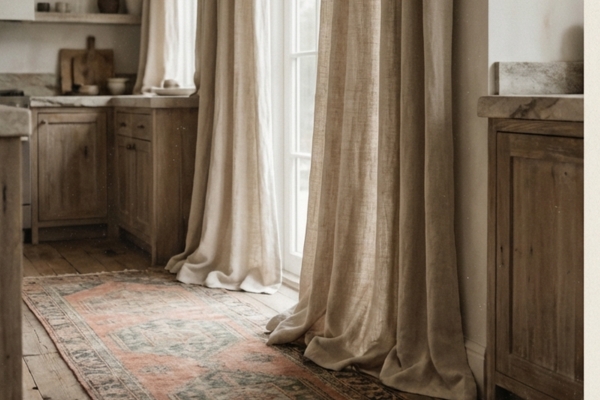
Then add rugs and curtains. People are using vintage rugs and soft linen curtains to make the space feel quieter and softer.
Third step: Embrace curated chaos
This means not hiding everything behind closed doors.
You can use open shelves to show a bit of your personality. Add pieces like handmade pottery, a small vintage painting, or your favorite cookbooks.
Fourth step: Treat the kitchen like furniture, not built-ins
Islands are starting to look more like tables — with legs, lighter shapes, and space to actually sit and gather.
And dining nooks, like built-in banquettes, bring that same cozy, stay-awhile feeling right into the kitchen.
It blurs the line between cooking and living — and that’s exactly the point.
Conclusion on Kitchen Design for 2026
These five trends aren’t just about making your kitchen look different. They’re about making it feel different.
After years of cold, perfect showrooms, we’re finally bringing warmth, personality, and real life back into the heart of the home.
Whether you’re planning a full renovation or just want to update a few elements, these trends give you permission to create a kitchen that actually feels like yours.